Blinds
Retractable vs Fixed Awnings – Which Is Right for Your Outdoor Space?
If you’ve spent any time at all trying to enjoy a British summer on a south-facing patio, you’ve probably had the “awning conversation.” You know the one, where you’re squinting through the glare, the ice in your drink is disappearing faster than a bank holiday weekend, and you finally admit that a parasol just isn’t cutting it for proper patio shade.
But once you start looking at patio awnings, you’re faced with a choice: Retractable or Fixed?
Choosing between the two isn’t just about what looks better in a brochure. It’s about how you actually live. Do you want flexible garden awnings for those (sadly rare) scorching summer days, or are you looking to create a “proper” outdoor room that stands up to a breeze and gives you protection so you can spend more time outside?
Before we dive into the details of the options, it’s worth checking out our guide on why we chose Markilux as our exclusive partner; it explains a lot about the engineering we’re talking about here. You might also want to look at our deep dive into the Markilux 990 if you’re leaning towards compact retractable awnings. Or, if you’re still early in the journey and doing your research, read our top 10 things to consider before buying.
What’s the Real Difference Between Retractable and Fixed Awnings?
In simple terms, it’s a choice between flexibility and permanence.
Retractable Awnings: These are the “now you see them, now you don’t” option. They mount to your wall, and when you want shade, they roll out on heavy-duty arms. When you’re done, they tuck away into a neat cassette, they’re fantastic for spring and summer.
Fixed Awnings: These are a more structural addition to your patio shade setup and can take more wind and weather than retractables. They have permanent supporting legs at the front. While the fabric roof can sometimes still retract, those legs are bolted down.
Why Choose Retractable Awnings?
The biggest mistake people make with retractable awnings is thinking they’re only for the garden. They often think they’ll get a shady patch outside, but with retractables, the shade is often inside. It’s all about the sun’s angle at different times of the day.
If your lounge or kitchen turns into a greenhouse by 2pm, these garden awnings are your best friend. It stops the sun before it even hits the glass, keeping your home cool without you having to sit in the dark with the curtains shut.
The Pros:
- Neat and tidy: They disappear when you don’t need them.
- Perfect for modern homes: Great for bi-fold doors where you want an unobstructed view in winter.
- High-tech: We always recommend motorised operation because winding a 3m awning manually is no small job! Add a wind sensor, and the awning will even tuck itself away if the weather turns while you’re out.
Why Choose a Fixed Patio Awning?
If you want to treat your patio like an extra room in the house, a fixed awning, like a pergola or veranda style, is the way to go. Because it has legs, it’s much more robust than standard retractable awnings.
A fixed awning can be enclosed with side panels and heating to create a true outdoor room. We recently saw this with a client who wanted to use their hot tub year-round. By opting for a fixed structure with some added heating, they turned a summer-only corner of the garden into a 365-day retreat.
The Pros:
- Better in a breeze: Because it’s anchored to the ground, it doesn’t “bounce” like a cantilevered retractable might.
- Larger projections: If you’ve got a larger patio, legs provide the support needed to cover more ground.
- The “Zone” factor: It defines an outdoor dining or lounge area much more clearly than a retractable does.
The Reality Check: Installation & Weather
Retractable awnings rely entirely on your house wall. You need solid brickwork and clear space. Fixed patio awnings need a solid “footing.” Whether that’s bolting into decking or pouring concrete pads under your paving, it’s a more involved job. It’s not a quick release, once those legs are in, they’re staying there; it’s an important decision.
And let’s talk about the wind. If you live on an exposed hill in the Cotswolds, a standard retractable might spend half the summer tucked away because the sensors keep pulling it in for safety. In that case, a fixed structure isn’t just a luxury; it’s a necessity if you actually want to use the patio shade you’ve paid for.
Which One Wins on Budget?
As you can imagine, fixed patio awnings are usually more expensive. You’re paying for more metal, more installation time, and a more permanent structure. They add more usable space to your home all year round. If a retractable awning gives you 50 usable days a year and a fixed awning gives you 200, the cost per use actually starts to look much better on the fixed option.
How to Decide: The 3-Question Test
If you’re still on the fence about which garden awnings are right for you, ask yourself these three things:
- What’s the goal? Cooling the house (retractable) or building an outdoor lounge (fixed)?
- How’s the wind? Is your garden a sheltered sun-trap or a wind tunnel?
- Is this your “Forever Home”? If you’re planning on staying put, the investment in a fixed structure adds genuine value and square footage.
Real-Life Inspiration
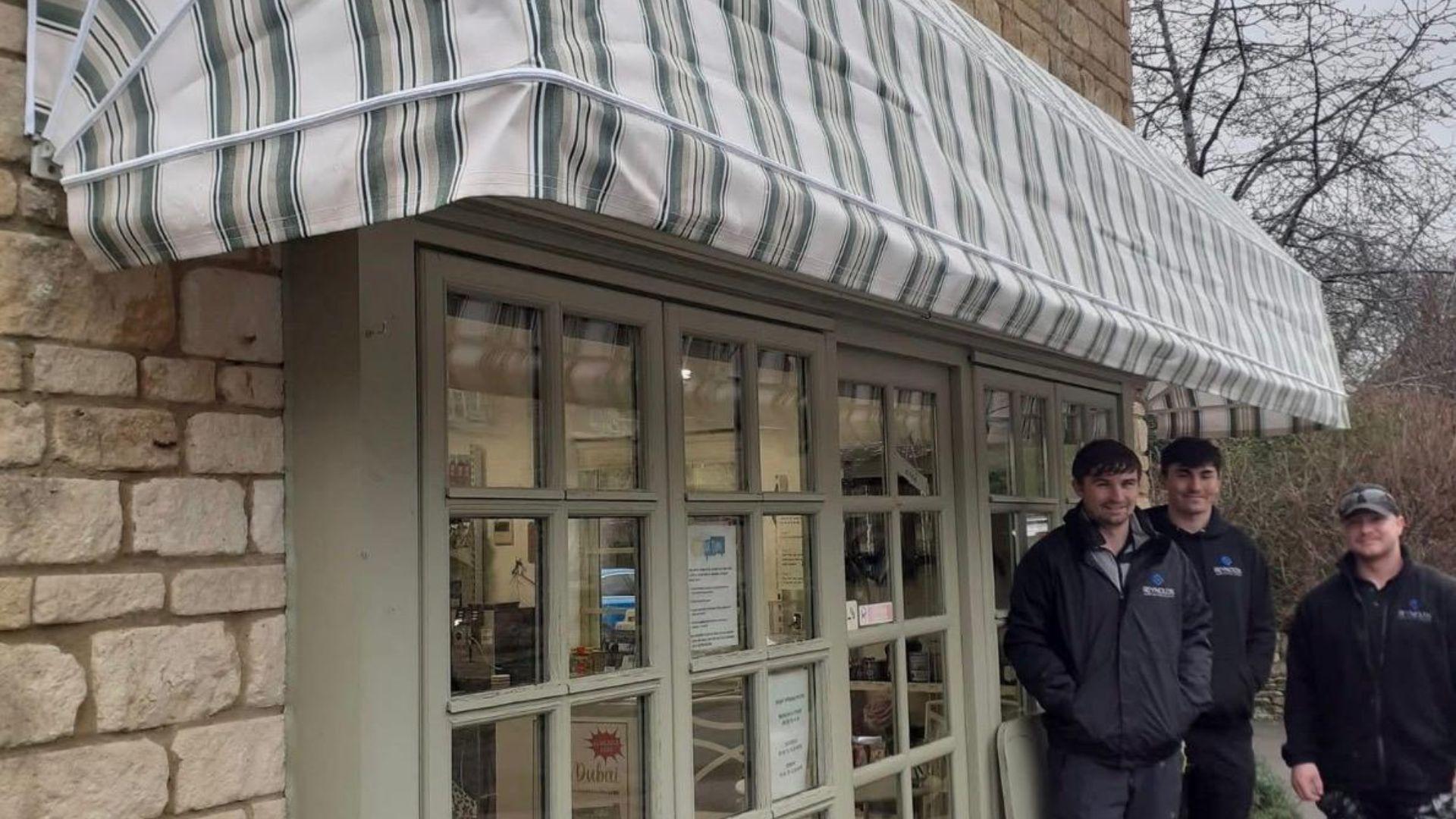
The Shop Front: We recently worked on a Cotswolds Village Shop. They needed a canopy so customers could queue in the shade and rain. A retractable would have been too flimsy for constant use, so a traditional canopy was the perfect fit. We love that they even did a GoFundMe to fund it, proof of how much a bit of shelter can mean to a community!
Ready to stop squinting?
Whether you want the sleek flexibility of retractable awnings or the year-round sturdiness of fixed patio awnings, we can help you figure out the best fit for your specific bricks and mortar.
👉 Explore our Patio Awnings Range or pop into one of our showrooms to see them in action.